

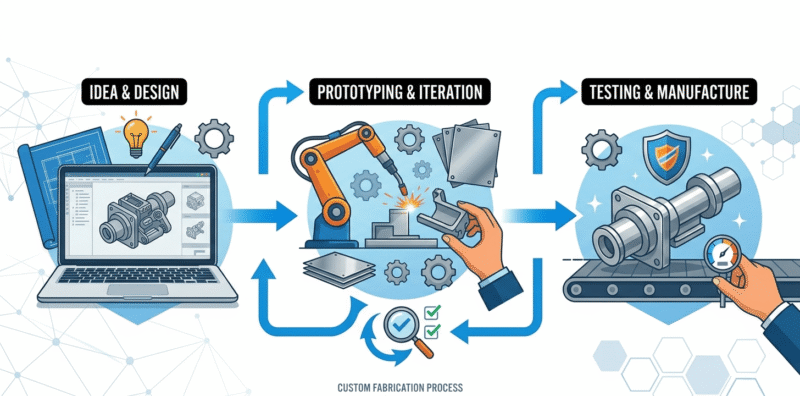
In today’s competitive manufacturing landscape, speed, flexibility, and precision are critical to successful product development. Businesses are under increasing pressure to bring innovative products to market faster, without compromising on quality or performance.
Custom metal fabrication plays a vital role in meeting these demands. By enabling tailored, high-precision components and rapid iteration, it supports every stage of the product development lifecycle. According to industry research, manufacturers that adopt flexible fabrication and prototyping processes can reduce development time by up to 30%.
Bridging the Gap Between Design and Reality
One of the biggest challenges in product development is transforming a digital concept into a functional physical product. Custom metal fabrication provides the essential link between design and manufacturing.
Using CAD-driven workflows, engineers collaborate closely with fabrication specialists to ensure designs are optimised for manufacturability. This reduces the risk of costly redesigns and production delays. Research into product development efficiency highlights that early-stage design collaboration can significantly reduce lifecycle costs.
Enabling Rapid Prototyping
Speed is a defining factor in modern product development. Custom metal fabrication enables rapid prototyping, allowing engineers to test and refine designs quickly without committing to full production runs.
Prototyping allows organisations to identify design flaws early and improve product performance before launch. Studies suggest that companies using rapid prototyping can accelerate time-to-market by 20-50%.
This ability to iterate quickly is particularly valuable in industries where innovation cycles are becoming shorter and more competitive.
Supporting Design Flexibility and Iteration
Product development is inherently iterative. Designs evolve based on testing, feedback, and changing requirements. Custom metal fabrication provides the flexibility needed to accommodate these changes without significant disruption.
Unlike traditional mass production, which often relies on fixed tooling, custom fabrication allows for design modifications with minimal additional cost. This adaptability is a key advantage in early-stage development, where multiple iterations are often required.
According to manufacturing trend analysis, flexible production systems are now a priority for over 70% of manufacturers.
Precision and Quality Assurance
Precision is essential in product development, particularly in sectors such as aerospace, automotive, and medical engineering. Custom metal fabrication ensures that components are produced to exact specifications, maintaining consistency across prototypes and production parts.
Advanced fabrication technologies, including CNC machining and automated inspection systems, enable tight tolerances and high repeatability. This contributes to improved product reliability and reduced defect rates.
Data shows that manufacturers implementing advanced quality control processes can reduce defects by up to 50%.
Cost Efficiency in Early-Stage Development
Although custom fabrication is often associated with low-volume production, it can offer significant cost advantages during product development. By producing only what is needed, companies avoid the costs associated with excess inventory and unused tooling.
Early-stage prototyping also helps identify issues before they escalate into expensive production problems. Research indicates that design changes made during the prototyping phase can cost up to 10 times less than those made during full production. This makes custom metal fabrication a cost-effective solution for innovation-driven projects.
Seamless Transition to Production
As products move from concept to production, maintaining consistency becomes critical. Custom metal fabrication providers can support both prototyping and full-scale manufacturing, ensuring a smooth transition between development stages.
This continuity reduces lead times and ensures that the final product aligns with the original design intent. Integrated manufacturing approaches have been shown to improve overall production efficiency by up to 25%.
Applications Across Industries
Custom metal fabrication supports product development across a wide range of sectors. In aerospace, it enables lightweight and high-strength components. In automotive engineering, it supports rapid prototyping and performance optimisation. In medical manufacturing, it allows for the creation of highly precise and customised components.
The global demand for custom fabrication continues to grow, driven by the need for innovation and product differentiation. Industry reports forecast steady growth in advanced manufacturing services over the next decade.
The Role of Technology in Modern Fabrication
Advancements in technology are enhancing the capabilities of custom metal fabrication. Automation, digital design tools, and smart manufacturing systems are improving both speed and accuracy.
Technologies such as CNC machining, laser cutting, and robotic welding enable complex designs to be produced efficiently, while data-driven processes help optimise performance and reduce waste.
According to Industry 4.0 research, manufacturers adopting digital technologies can increase productivity by up to 20%.
Our Final Thoughts
Custom metal fabrication is a critical enabler of modern product development. By supporting rapid prototyping, enabling design flexibility, and ensuring high precision, it helps businesses bring innovative products to market faster and more efficiently.
For companies like Knees Engineering, offering advanced fabrication capabilities means providing clients with the tools and expertise needed to succeed in a fast-moving, innovation-driven environment.
As manufacturing continues to evolve, the role of custom metal fabrication will only become more important, helping businesses stay competitive, reduce risk, and deliver high-quality products with confidence.