Welding services at Knees Engineering

Welding often forms a key part of the fabrication process as it ensures the final component or structure is durable, robust and fit for purpose. 

With full facilities for MIG and TIG welding, Knees Engineering is well equipped to take on high volume welding contracts.

Our up-to-date machinery includes a fast and efficient robotic arm that enables us to complete large batch jobs quickly and accurately.

Speak to a member of the team today to find out more.


dots

Welding often forms a key part of the fabrication process as it ensures the final component or structure is durable, robust and fit for purpose. 

With full facilities for MIG and TIG welding, Knees Engineering is well equipped to take on high volume welding contracts.

Our up-to-date machinery includes a fast and efficient robotic arm that enables us to complete large batch jobs quickly and accurately.

Speak to a member of the team today to find out more.


Common welding techniques

There are in fact more than 30 different ways to weld, although in reality only a select few of these methods are actually used in modern metal fabrication. Here’s a brief overview of some of the most popular techniques used today.
MIG welding join close up

MIG/MAG welding

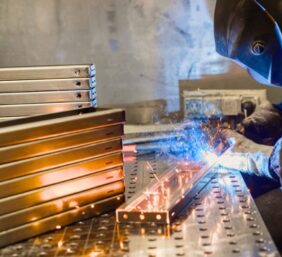
During the MIG (Metal Inert Gas)/ MAG (Metal Active Gas) welding process an electrical arc is created between an electrode wire and the workpiece metal. The arc melts the electrode wire to create the weld. The weld pool then cools and solidifies to form a new piece of fused metal. An inert gas protects the weld puddle from atmospheric contamination, acting as a shield to enable the metals to be welded.
TIG welding

TIG (Tungsten Inert Gas) welding also produces an electric arc between the workpiece and the electrode. Unlike MIG welding, however, the process uses a tungsten electrode to run a current through the metals that need to be fused. Again, an inert gas, for example, argon, protects the weld puddle from the damaging effects of the surrounding air.


Spot welding

Spot welding is an electric resistance welding process that’s typically used to join sheet metal. Copper alloy electrodes focus an electrical current in a small area between the metal surfaces that need to be joined. The heat created by the electrodes melts the metals together at a precise point, or spot, on the workpiece. The electrodes also exert pressure to help keep the materials in place. 

Stud welding machine close up

Stud welding

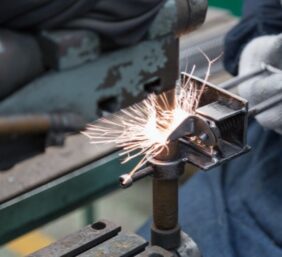
Stud welding is a versatile process in which metal fasteners such as weld studs, weld pins and tapped studs are joined to a base metal. An electrical arc is produced between the end of the stud and the surface of the workpiece, melting both parts. Once a molten pool forms, the part and workpiece are pressed together to form the join. Stud welding is a fast and reliable technique, with the welded joints typically being stronger than the parent material itself. 

Welding expertise you can rely on

As well as having the right equipment, the welding process requires specialist expertise – and that’s where we excel.

With a wealth of experience behind them, our highly skilled welding team can select and perform the most suitable welding method for a particular job and material.

If you have a welding or metal fabrication project you’d like to discuss, please call or email us today and we’ll be happy to help.

What is welding?

minus icon plus icon
Welding is a crucial part of the fabrication process that involves joining two materials together (usually metals) using extreme heat.

The parts are melted (fused) together and, once cooled, the joints harden and create a final fabricated structure. Although often used interchangeably, welding is different from soldering and brazing as these processes do not melt the base material.

There are several methods for welding sheet metal; the most appropriate technique will depend on the type of metal and its intended purpose. The most common methods are MIG and TIG welding but other techniques can be used for more specialist jobs.

As you might expect, welding has a huge variety of applications and is used across a wide range of industries including oil and gas, seating systems, automotive and construction.

Why choose Knees Engineering?

minus icon plus icon

Get in touch today to arrange a free quote

We will be happy to talk you through our range of welding and metal fabrication services to help you find the most suitable and cost-effective option for your needs.
01225 753894
  • This field is for validation purposes and should be left unchanged.
  • Accepted file types: dxf, dwg, nc, nc1, cdl, iges, step, prt, sldprt, asm, sldasm, jpeg, jpg, png, Max. file size: 20 MB.
    .dxf .dwg .nc .nc1 test .cdl .iges .step .prt .sldprt .asm .sldasm

Other services we can offer

At Knees Engineering we can perform a variety of other processes to meet your needs.

We offer a wide range of fabrication services including laser cutting, punching, CNC machining and bending.

Explore