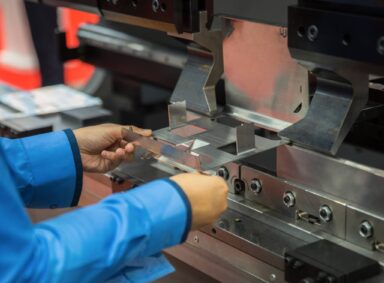
Metal bending at Knees Engineering

As experts in sheet metal fabrication, we offer an expansive range of precision metal bending and forming services to meet our customers’ needs and project specifications.

Our Wiltshire-based workshop has three press brakes including an Amada HD 1303 NT, an Amada HF 5012 T and an Amada HF EM 21003.

In the hands of our highly qualified and experienced engineers, these modern tools can bend and shape all manner of metal components with a high degree of accuracy.

Contact us today to discuss how we can help with your next metal bending project or to request a quote. 

dots

As experts in sheet metal fabrication, we offer an expansive range of precision metal bending and forming services to meet our customers’ needs and project specifications.

Our Wiltshire-based workshop has three press brakes including an Amada HD 1303 NT, an Amada HF 5012 T and an Amada HF EM 21003.

In the hands of our highly qualified and experienced engineers, these modern tools can bend and shape all manner of metal components with a high degree of accuracy.

Contact us today to discuss how we can help with your next metal bending project or to request a quote. 

Our metal bending capabilities

We can bend a variety of materials up to 12mm including:

  • Mild steel
  • Stainless steel
  • Aluminium
  • Brass
  • Copper
  • Bendable plastics

Please see the table for our current press brake specifications.

We also utilise CNC technology to speed up production times and ensure products are delivered within the shortest possible lead time – and all while maintaining exceptional quality.

Amada HD 1303 NT Amada HF 5012 TAmada HF EM 21003
Tonnage13050 100
Max material width/length3m1.2m3m

Metal bending techniques

There are several methods that can be used when metal bending on a press brake.

The exact technique used will depend on a variety of factors unique to the project, such as the angle of the bend required and the type of material. The three main techniques are:

Air bending

The punch is driven into the die opening to create the bend, although only the top two corners of the V-die actually touch the material. The angle of the bend is determined by how far the punch descends into the die. Air bending requires less pressure to make the bend compared with other techniques, plus no retooling is necessary. This method of bending is the technique we utilise in our factories at Knees Engineering.

Bottom bending

During this technique, the punch and die are brought together so that the metal makes contact with the punch tip and the sidewalls of the V-opening. Bottom bending requires more pressure than air bending but it can create more accurate angles. However, as each bend radius requires a specific die, the process can be more complex and time-consuming than air bending.

Coining

Coining is a more basic bending technique in which an extreme amount of pressure is exerted to stamp the sheet metal between the punch and die. With enough weight, the metal conforms to the exact angle of the punch and die being used. While the technique can create a very precise angle, the considerable tonnage required to achieve the bend means the method is now less popular than air bending and bottom bending.


What is metal bending?

Sheet metal bending, also known as press braking or folding, is a key stage of the metal fabrication process.

It refers to the action of bending, folding and pressing sheet metal into the required angle or shape.


The metal bending process

minus icon plus icon
The process is typically carried out using a tool known as a press brake, which consists of an upper tool called a punch and a lower tool called a die.

When the sheet metal is pressed between the punch and the die, it is forced to bend at an angle. The result is usually a ‘V’ or a ‘U’ shape bend. The precise bend angle is determined by the depth to which the punch forces the sheet metal into the die.

Although press brakes can be operated manually, most are now controlled via a computer. CNC technology enables the press brake to be programmed to create multiple, intricate and precise bends automatically within minutes, helping to speed up production times and minimise costs.

Metal folding is usually just one stage of the metal fabrication process – it’s often preceded by a cutting process and followed by the assembly stage. At Knees Engineering, our metal bending and forming work is the perfect complement to our other metal fabrication services. 

Metal bending techniques

minus icon plus icon

Why choose Knees Engineering?

minus icon plus icon

Get in touch today to arrange a free quote

We will be happy to talk you through our range of metal fabrication services to help you find the most suitable and cost-effective option for your needs.
01225 753894
  • This field is for validation purposes and should be left unchanged.
  • Accepted file types: dxf, dwg, nc, nc1, cdl, iges, step, prt, sldprt, asm, sldasm, jpeg, jpg, png, Max. file size: 20 MB.
    .dxf .dwg .nc .nc1 test .cdl .iges .step .prt .sldprt .asm .sldasm

Other services we can offer

At Knees Engineering we can perform a variety of other processes to meet your needs.

We offer a wide range of fabrication services including laser cutting, CNC punching, CNC machining and various welding techniques.

Explore