

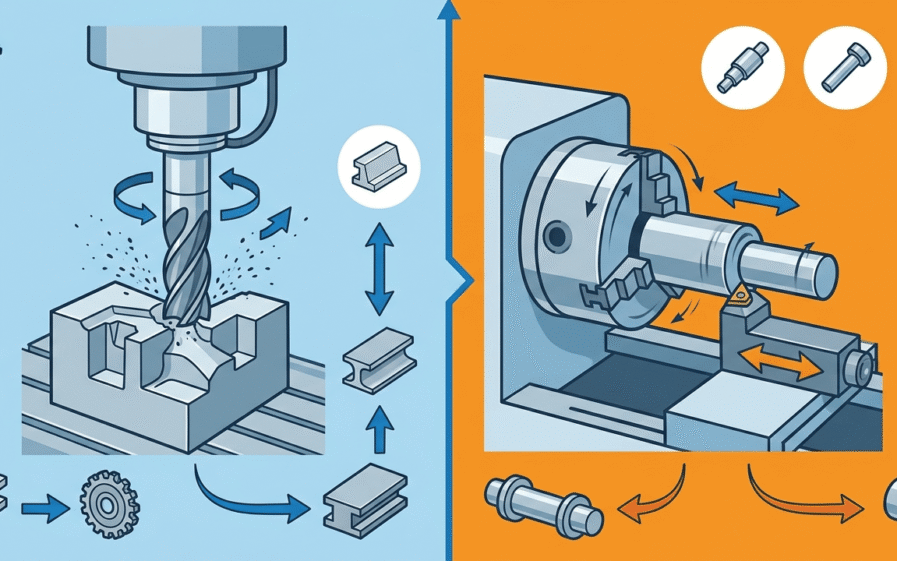
CNC machining is at the heart of modern precision engineering, enabling the production of high-tolerance components for industries such as aerospace, automotive, medical, and defence. Two of the most important CNC machining processes are CNC milling and CNC turning. Understanding the differences between CNC milling vs CNC turning is essential when selecting the right manufacturing process for your components.
This guide explains the key differences between CNC milling and CNC turning, helping you choose the most efficient and cost-effective CNC machining solution for your application.
What Is CNC Milling?
CNC milling is a subtractive manufacturing process where a rotating cutting tool removes material from a workpiece. Unlike turning, the workpiece remains relatively stationary while the tool moves along multiple axes.
CNC milling is ideal for producing complex geometries, including pockets, slots, flat surfaces, and intricate 3D contours. Multi-axis CNC milling machines—such as 3-axis, 4-axis, and 5-axis machining centres, enable highly precise machining of complex parts in a single setup.
CNC milling is widely used when parts require non-rotational symmetry and complex surface features.
What Is CNC Turning?
CNC turning is a machining process performed on a lathe, where the workpiece rotates at high speed while a stationary cutting tool removes material. This process is specifically designed for producing cylindrical or rotationally symmetrical components.
CNC turning is highly efficient for manufacturing parts such as shafts, bushings, and threaded components. The continuous cutting action results in excellent surface finishes and high levels of concentricity.
CNC Milling vs CNC Turning: Key Differences
The primary difference between CNC milling and CNC turning lies in how the cutting action is performed. In milling, the cutting tool rotates, whereas in turning, the workpiece rotates. This fundamental distinction affects everything from part geometry to machining efficiency.
CNC milling is best suited for complex parts that require multiple features and non-rotational shapes. CNC turning, on the other hand, excels at producing round components with high precision and fast cycle times.
From a manufacturing perspective, turning is often more efficient for high-volume production of cylindrical parts, while milling is more versatile for intricate designs and low-to-medium volume production.
CNC Machining Capabilities and Applications
CNC milling is typically used for components that require detailed machining across multiple faces. It is commonly applied in the production of tooling, moulds, and precision-engineered components with complex geometries.
CNC turning is ideal for parts that require tight tolerances on diameters and excellent concentricity. It is widely used in industries where precision cylindrical components are critical, such as shafts and fasteners.
In modern CNC machining, many manufacturers use hybrid mill-turn machining, which combines both CNC milling and CNC turning in a single machine. This approach reduces setup time and improves overall machining accuracy.
CNC Milling vs CNC Turning: Tolerances and Surface Finish
Both CNC milling and CNC turning can achieve tight tolerances, but they excel in different areas.
CNC turning generally produces superior surface finishes on cylindrical parts due to its continuous cutting action. It also provides excellent dimensional accuracy for round features.
CNC milling is highly capable of producing precise flat surfaces and complex 3D geometries. The surface finish depends on factors such as tool selection, feed rate, and machining strategy.
CNC Machining Efficiency and Cost Comparison
When comparing CNC milling vs CNC turning in terms of cost and efficiency, turning is usually more economical for cylindrical components. The continuous rotation of the workpiece allows for faster material removal rates and shorter cycle times.
CNC milling can be more time-consuming due to tool changes and complex toolpaths, but it is essential for parts with intricate geometries. The cost of CNC milling is often justified when flexibility and design complexity are required.
Production volume also plays a key role. CNC turning is typically more cost-effective for high-volume production runs, while CNC milling is better suited to low and medium-volume production of complex parts.
Choosing Between CNC Milling and CNC Turning
Selecting the right CNC machining process depends on several factors, including part geometry, tolerance requirements, and production volume.
If your component is cylindrical or requires high concentricity, CNC turning is usually the best option. If your part involves complex shapes, multiple faces, or detailed features, CNC milling is more appropriate.
In many cases, a combination of both processes, using mill-turn machining – provides the most efficient solution, especially for complex components that require both rotational and prismatic features.
CNC Milling and CNC Turning Services at Knees Engineering
At Knees Engineering, we provide expert CNC machining services, including precision CNC milling and CNC turning. Our advanced machining capabilities allow us to manufacture high-quality components to exact specifications, whether for prototype development or full-scale production.